Christmas in Germany

A big part of the Christmas celebrations in Germany is Advent. Several different types of Advent calendars are used in German homes. As well as the traditional one made of card that are used in many countries, there are ones made out of a wreath of Fir tree branches with 24 decorated boxes or bags hanging from it. Each box or bag has a little present in it. Another type is called a 'Advent Kranz' and is a ring of fir branches that has four candles on it. This is like the Advent candles that are sometimes used in Churches. One candle is lit at the beginning of each week in Advent.
Christmas Trees are very important in Germany. They were first used in Germany during the late Middle Ages. If there are young children in the house, the trees are usually secretly decorated by the mother of the family. The Christmas tree was traditionally brought into the house on Christmas Eve. In some parts of Germany, during the evening, the family would read the Bible and sing Christmas songs such as O Tannenbaum, Ihr Kinderlein Kommet and Stille Nacht (Slient Night).
Sometimes wooden frames, covered with colored plastic sheets and with electric candles inside, are put in windows to make the house look pretty from the outside. There is also the tradition of Scherenschnitte (paper cutting) where Christmas shapes like bells and nativity scenes were cut out of paper and then different colored transparent paper was put behind the openings to make them look like stained glass.
Christmas Eve is the main day when Germans exchange presents with their families.
In German Happy/Merry Christmas is 'Frohe Weihnachten'. Happy/Merry Christmas in lots more languages.
Christmas Day is called “Erster Feiertag” ('first celebration') and the 26th December is known as 'Zweiter Feiertag' ('second celebration') and also 'Zweiter Weihnachtsfeiertag'. This is another day off work and is like Boxing Day in the UK and some other countries.
In some parts of Germany, mainly the south east of the country, children write to the 'das Christkind/Christkindl' asking for presents. The letters to the Christkind are decorated with sugar glued to the envelope to make them sparkly and attractive to look at. Children leave the letters on the windowsill at the beginning of or during Advent.
'das Christkind' translates as 'The Christ Child' in English but Germans don't think of the Christkind as the baby Jesus! The Christkind is often described as a young girl with 'Christ like' qualities. In Nürnberg (Nuremberg) a young girl is chosen every year to participate in a parade as the Christkind. She wears a long white and gold dress, has long blond curly hair and wears a gold crown and sometimes wings like an angel. This is similar to St Lucia is Sweden. (And it can seem a bit confusing calling the 'Christ Child', Jesus, a girl!)
Santa Claus or Father Christmas (der Weihnachtsmann) brings the main Christmas presents on December 24th. You might also write a letter to Weihnachtsmann in other parts of Germany. Some people say that Santa/Father Christmas (Weihnachtsmann) brings the presents and some say it is Christkind!
As well as hoping for presents from Christkind or der Weihnachtsmann, some children also hope that 'der Nikolaus' will bring you some small gifts, such as sweets and chocolate on the 6th December (St Nicholas's Day). He comes in the night between the 5th and the 6th and puts the presents into the shoes of children, who usually place them by their doors. He might also knock on the door and the children will have to sing a song, play a song on an instrument or tell a story to St Nicholas before he gives them their presents.
In some regions of Germany, there is a character called "Knecht Ruprecht" (black Rupert) or "Krampus" who accompanies Nikolaus (St. Nicholas) on the 5th and 6th of December. He is big horned monster clothed in rags and carries chains. He is meant to punish the children who have been bad! He is usually the one who scares the little children. In some places there's Krampusnacht (Krampus Night) on the evening of the 5th of December. There are parades of people dressed as Krampus. These are known as Krampuslauf (Krampus run). Krampusnacht can be quite scary!
In other parts of Germany, St. Nicholas is followed by a small person called "Schwarzer Peter" (Black Peter) who carries a small whip. Black Peter also accompanies St. Nicholas or Sinterklaas in The Netherlands. In north west Germany Santa is joined by Belsnickel a man dressed all in fur. Although 'der Nikolaus' visits in December, he's not officially part of Christmas!
There are some other historic female gift bringers in some parts of Germany. In the areas around Hesse and Thuringia, Frau Holle might bring you presents over the 12 Days of Christmas. In villages around Mecklenburg, in north east Germany, Frau Gaude is meant to go through the streets of villages followed by lots of dogs!
In Bavaria, folklore says that Perchta would bring coins to good children between Christmas and Epiphany, but if you've been naughty, bad things would happen to you!
In the very south west of Germany, and in neighboring parts of France and Switzerland, you might get presents from 'Tante Arie'. This gift bringer is based on Countess Henriette de Montbéliard and Wurtemberg who lived in the 12th and 13th centuries. She was very kind to the people in the lcoal area. After she died, legends of her generosity started to be told. 'Tante' means 'Aunt' in German and 'Arie' comes from 'Henriette'. She is now a figure like Befana in Italy.
At small work places and school parties, secret presents are often exchanged. Sometimes a door is opened just wide enough for small presents to be thrown into the room. The presents are then passed around among the people until each person has the correct present! It is thought to be bad luck to find out who sent each present.
Secret Santa might also be known as 'Wichtel' (a small Christmas gnome/elf) where you give sometime a small gift or do something nice for them. There's also a relatively new version of Secret Santa in Germany called 'Schrottwichteln' (Scrap or Rubbish Secret Santa) where all the gifts are old/useless/junk/something you don't want! Schrottwichteln can also be played with 'white elephant' type rules.

Germany is well known for its Christmas Markets (called Christkindlmarkt) where all sorts of Christmas foods and decorations are sold.
Cologne has the largest Christmas market in the world. It's made of over seven markets which taken place throughout the city. About six million people visit it every Christmas. Cologne has its own special Christmas gnomes called Heinzelmännchen. Figures of them are on display in the markets; they even have a market named after them the 'Heinzels Wintermärchen' which is famous for its skating rink. Cologne Cathedral also holds some relics said to be the bones belonging to the Wisemen who visited Jesus.
The Nürnberg (Nuremberg) Christkind officially opens the Christmas market on the Friday before Advent starts. And before Christmas she has over 150 'official duties' including visiting hospitals, old people's homes and children's nurseries! She also has to give TV interviews and visit other cities.
Perhaps the most famous German decorations are glass ornaments. The glass ornaments were originally hand blown glass and were imported in the USA in the 1880s by the Woolworth stores. The legend of the glass 'Christmas Pickle' is famous in the USA, but it's that, a legend. Most people in Germany have never heard of the Christmas Pickle! Traditional wooden decorations, such as Nutcrackers and Zwetschgenmännla and Pflaumentoffel ('Prune People') are also popular.
Another tradition is the Sternsinger (or star singers) who go from house to house, sing a song and collect money for charity (this is a predominantly Catholic tradition). The singers are normally four children, three who dress up like the Wise men and one carries a star on a stick as a symbol for the Star of Bethlehem. When they're finished singing, they write a signature with chalk over the door of the house. The sign is written in a special way, so 2023 would be: 20*C*M*B*23. It is considered to be bad luck to wash the sign away - it has to fade by itself. It has usually faded by the 6th of January (Epiphany). The Sternsingers visit houses between December 27th and January 6th.


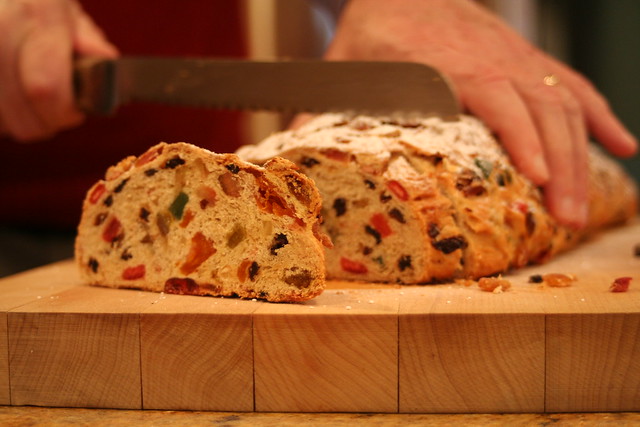
Carp or Goose are often served for the main Christmas meal. Stollen is a popular fruited yeast bread that is eaten at Christmas. Here is a recipe for Stollen.
Over Christmas and the New Year in Germany and Austria, the famous Ski Jumping 'Four Hills Tournament' ('Vierschanzentournee') is held. It starts in Germany with Oberstdorf (Germany) on the 29th or 30th December and Garmisch-Partenkirchen (Germany) on New Year's Day and continues in Austria with Innsbruck (Austria) on 3rd or 4th of January and Bischofshofen (Austria) on the 6th January.
During the evening of New Year's Eve, the 1963 comedy sketch 'Dinner for One' is shown on TV (it's also called 'The 90th Birthday' and in German it's known as 'Der 90. Geburtstag'). It's very popular and is the most repeated show ever on German TV! It's also shown on TV on New Year's Eve in Austria, Switzerland, Denmark, Sweden, Finland and Estonia. In Norway, it's shown on during the evening of the 23rd of December.
Last Updated: | Sources Information | Written by: James Cooper